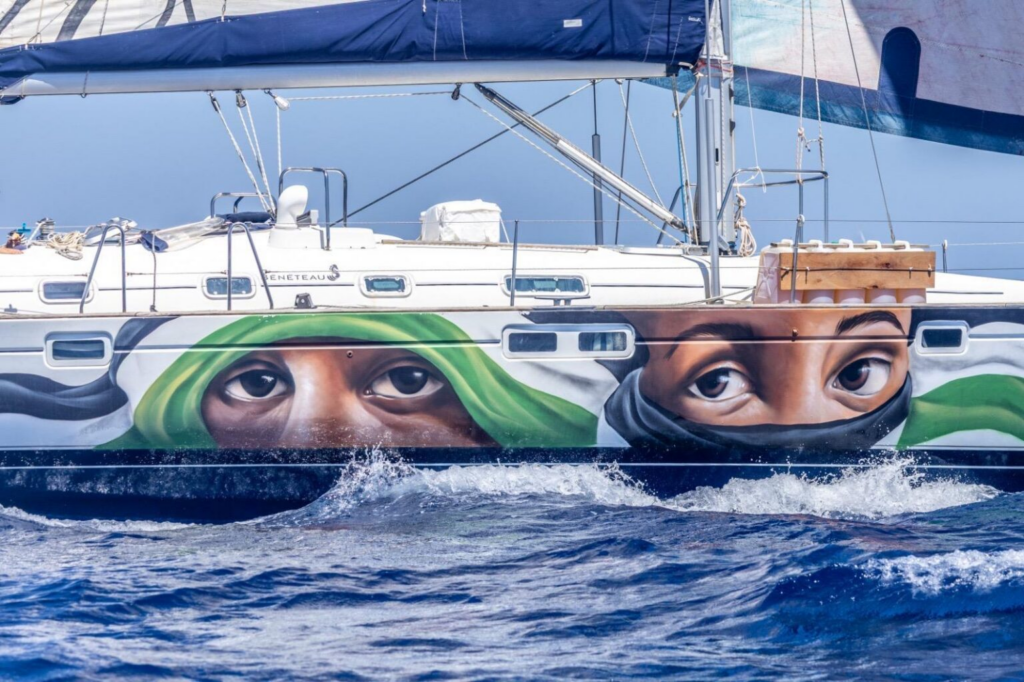
On April 15, 2026, the Global Sumud Flotilla set sail from Barcelona bound for occupied, starving, and devastated Gaza, carrying medical supplies and food on board to open a humanitarian sea corridor. I had the privilege of serving as captain on one of the boats, along with nine other people.
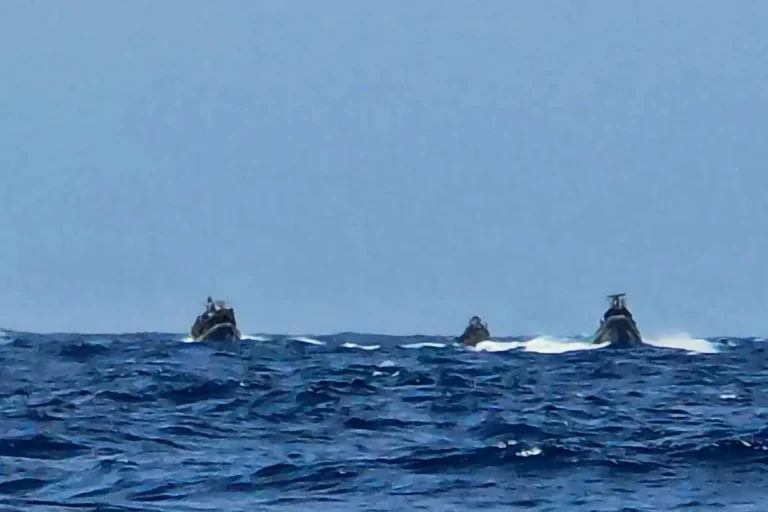
We were one of more than 50 boats en route to Greece when, on April 29, we were stopped by Israeli military boats west of Crete after being fired upon with rubber bullets. The crew was kidnapped, taken to an Israeli prison ship, mistreated, and handed over to the Greek coast guard two days later south of Crete.
On May 14, 54 boats set sail from Marmaris, Turkey, bound for Gaza. I was the captain of a small sailing vessel. On May 18, this boat was also stopped with rubber bullets, and the seven-member crew was kidnapped. First, we were taken to a prison ship for two days, then transported via the port of Ashdod to Ktziot Prison in the Negev Desert, where we were held for one day. As a medical professional, I helped treat the numerous injured people both on the prison ship and in the prison.
Significant portions of this report are also documented in the records of the Turkish police in Marmaris and Istanbul, as well as the Federal Police in Hanover. This report describes the systematic torture of nonviolent participants in the Global Sumud Flotilla to highlight the far worse violence that the over 9,000 political prisoners in Israeli prisons have had to endure every day for decades. These people are often imprisoned without a court verdict or charges.
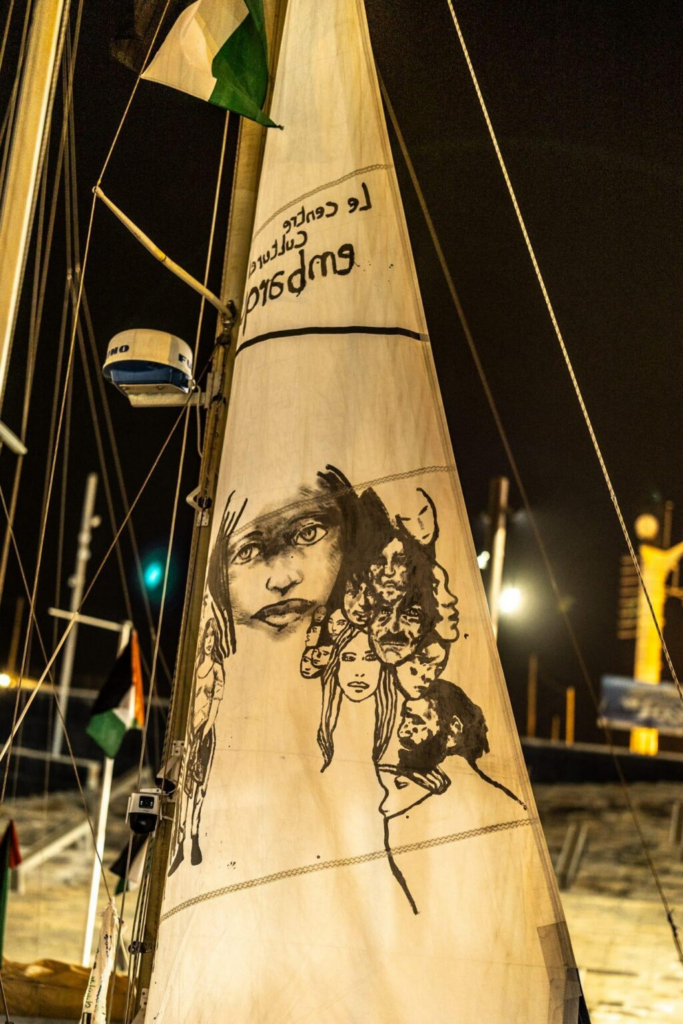
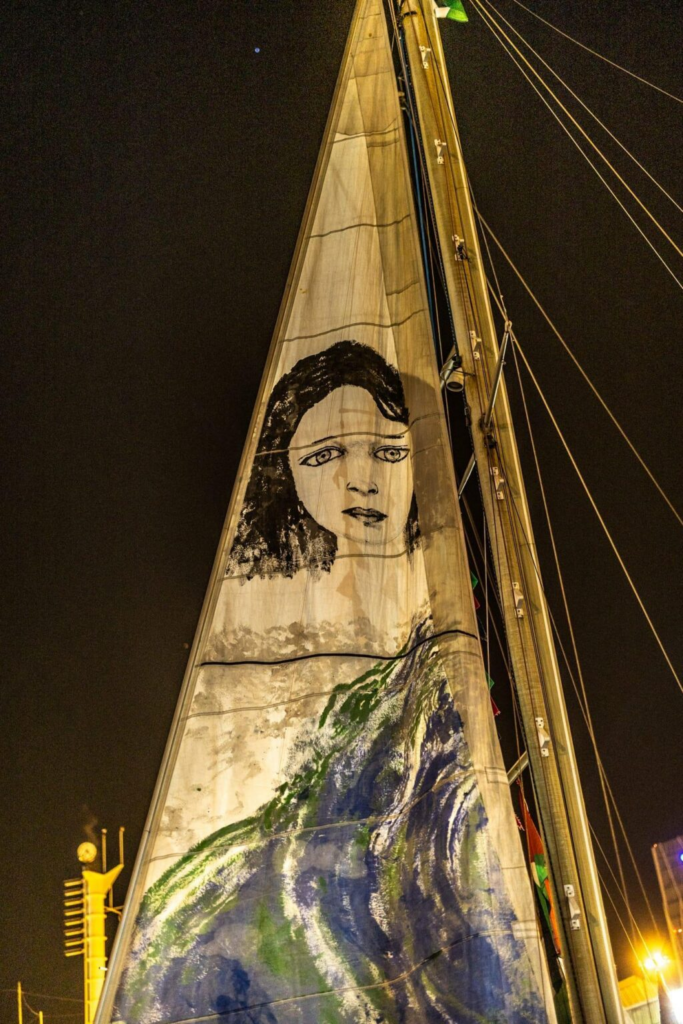
Our sails symbolize sumud, the resilience of Palestinian people.Just as the people living under occupation in oppressed Palestine are resisting, so too do we wish to resist. The Global Sumud Flotilla is nonviolent, persistent, and determined.
Trigger warning: Description of physical and psychological violence
“Who is the captain?” I was kneeling on the aft deck of our boat along with seven other hostages, hands behind my head, face pressed against the floor. Late in the evening of April 29, 2026, we and 21 other boats had been attacked in international waters in the Mediterranean Sea off the coast of Crete.
Israeli military speedboats kidnapped us after firing rubber bullets at us. A plexiglass panel was shot through—apparently with the intention of hitting two people at the helm.
The first of the four marines who boarded the ship smashed our live-streaming webcam. After two drone flyovers with spotlights shortly before, they obviously knew the camera’s location. He threw it into the sea, and another then threatened: “If you don’t say who the captain is, this will be much harder for you!” The three men and one woman were about twenty to twenty-five years old.
The eight-member crew of peaceful activists from the Global Sumud Flotilla had trained for the boarding of the boat by armed soldiers: Provide no pretext for violence, no quick movements that could be interpreted as an attack, no objects that look like weapons—de-escalation. Everyone had taken their assigned seats. But we had also agreed on Sumud—to stand firm, to offer nonviolent resistance. So we had decided not to answer the question about the captain.
Suddenly, boots were next to my head. The person kneeling next to me was yelled at: “If you don’t say who is the Captain, I will taser you in the face.” I heard the crackling sounds of a stun gun. We hadn’t expected threats of torture. What should we do? No one said a word—out of sheer terror or because we were sticking to our agreement? Full speed ahead toward the prison ship, whose floodlights shone brightly in the distance. I knew: in a few minutes, the coolant in our diesel engine would boil. A deafening beeping —the overheating alarm. The soldiers were in a frenzy. The threat again: “Who is the captain? If you don’t say it, I will taser you in the face.” Again, no answer, despite the sounds of the taser.
Article 3 of the European Convention on Human Rights states: “No one shall be subjected to torture or to inhuman or degrading treatment or punishment.” The European Court of Human Rights has ruled that the threat of torture constitutes a violation of a core right under the European Convention on Human Rights. The report by the UN Special Rapporteur dated March 23, 2026, on the systematic use of torture by Israel against Palestinians since October 7, 2023, states in paragraphs 76 and 77: High-ranking Israeli ministers described torture as a “sacred duty,” investigations into torturers as treason, and the perpetrators as “heroic warriors.” A rabbi reportedly recited blessings, and the public largely rejected calls for investigations.
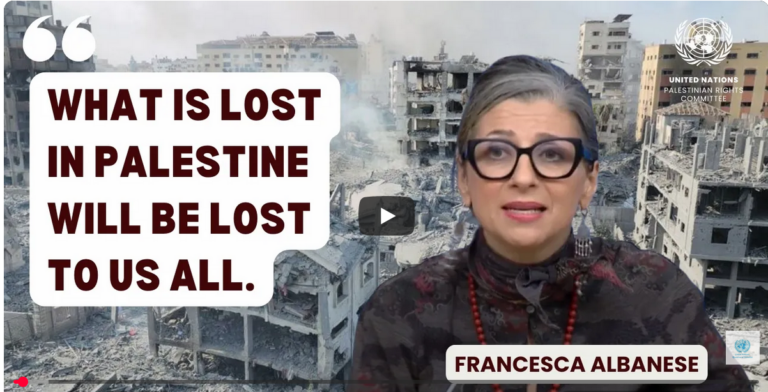
On March 23, 2026, Francesca Albanese reported to the Human Rights Council in Geneva on the “widespread and systematic use of torture” in Israel. She described the pervasive “climate of torture” to which Palestinians in the occupied Palestinian territory are subjected.
The repeated threats of torture against peaceful and nonviolent civilians on the Global Sumud Flotilla must be viewed against the backdrop of the attitude prevalent in Israel that there is a “right to torture.” Palestinians, however, face far worse treatment.
The UN report describes how Israel’s systematic use of torture against Palestinians since October 7, 2023, has reached the threshold of genocide as defined by the Convention on the Prevention and Punishment of the Crime of Genocide. It outlines how torture has become an integral part of the oppression and punishment of men, women, and children, both through mistreatment in detention and through a relentless campaign of forced displacement, mass killings, deprivation, and the destruction of all means of subsistence, aimed at causing long-term collective suffering and misery. A continuous regime of psychological terror is being created, permeating the entire territory, aimed at breaking bodies, robbing a people of their dignity, and driving them from their land.
This is not random violence. It is the architecture of settler colonialism, built on a foundation of dehumanisation and sustained by a policy of cruelty and collective torture – according to the report by UN Special Rapporteur Francesca Albanese.
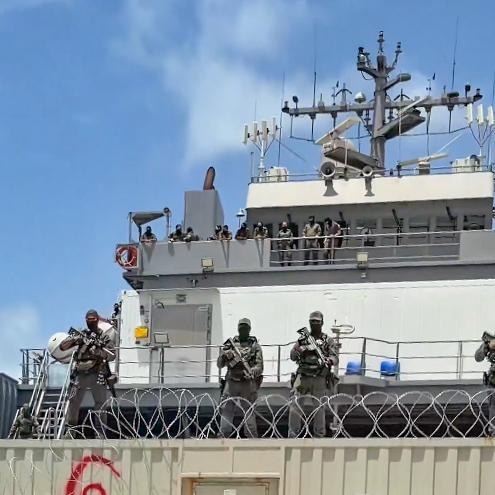
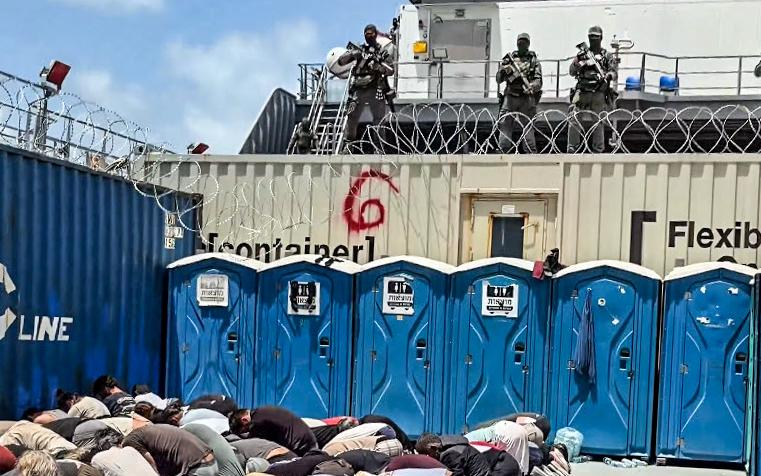
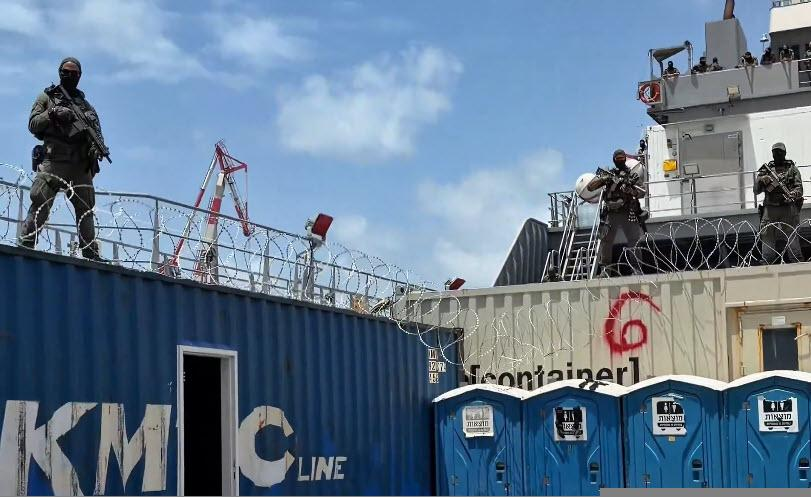
Israeli marines on the containers, prison guards and officers on the bridge of the prison ship
Trigger warning: description of physical and psychological violence
Numerous activists from the Global Sumud Flotilla were kidnapped twice within three weeks and forcibly taken to Israeli Navy prison ships. One of the two was later dubbed the “torture ship”. This report concerns that vessel.
18 May, 2 pm: With my neck brutally pressed down, my face to the ground and my right arm twisted behind my back, a soldier from the Israel Defence Forces shoved me into the white entrance container of the 95-metre-long prison ship. We later called this entrance to the prison the ‘torture container’ – all 190 participants of the Global Sumud Flotilla who were dragged there had to pass through it. Inside, five soldiers and prison guards were waiting. One ripped my shoes off, another my glasses; I was punched and kicked in the ribs and back; my arm was brutally pulled up twice; I screamed in pain. Shocked and stunned by the unexpected and unprovoked violence in the torture container, I staggered into the arms of those waiting. More muffled sounds of blows and people falling from the container. Waiting helplessly, with tears in our eyes, hour after hour, we heard the tortured screaming. Bleeding people with torn clothes, eyes wide with terror, disoriented, some hurled to the floor, others caught before they fell. Men with dark skin were particularly affected. White people, like me, were often just beaten and kicked, but not visibly injured. Muslim women were humiliated by having their headscarves, the sign of their piety, torn away.
Everyone had their jumpers and jackets stolen. Cold nights on the steel floor of the three overcrowded 12-by-3-metre sleeping containers, without blankets or mats, using squashed plastic bottles as pillows. Some stood up, others paced up and down outside to keep warm. I was most likely to get any sleep in the morning, when the sleeping containers were warm and less crowded. Two toilets with no toilet paper for 190 people and not enough water. Dry bread as the only food.
The humiliations inflicted by Israeli soldiers and prison guards only strengthened our sumud, our determination to open a humanitarian corridor to Gaza. Only two out of eight toilets were open for 190 people, and there was no toilet paper.
In the morning, the door to the torture container was flung open. Three soldiers, armed with rifles and dressed in full military uniform, hurled three stun grenades into the courtyard at the fifty or so terrified prisoners. The blast from the flashbangs echoed painfully off the steel containers; people scattered in all directions, disoriented. Later, two people showed me shrapnel wounds on their lower legs. We were shouted at: “Hands up!” Protected by three prison guards with shields, the laser sights on the rifles were trained on the assembled crowd. The container near the entrance was cleared. Two soldiers searched and secured it, keeping their weapons at the ready. Four people were ordered to approach the soldiers backwards and to collect plastic bottles and breadcrumbs using bin bags. Walking backwards, led by another soldier, with their weapons constantly trained on the people, the soldiers and prison guards retreated into the torture container. One returned and collected the debris from the stun grenades. On the ship’s elevated command bridge, some 30 metres away, overlooking the prison yard, the prison guards’ superiors and the officers applauded – clearly very satisfied at how unarmed and non-violent people had been injured, threatened and humiliated for no reason.
A prison guard opened the door to the torture container and placed my shoes and glasses in the middle of the courtyard. On one occasion, a few of the stolen jumpers were returned, and now and then we were given some water. We knew that all of this was being filmed and would be used as publicity material to demonstrate the impeccable humanitarian treatment of the prisoners.
In the afternoon, a soldier aimed his rifle scope from above at individuals in the prison yard. A German participant was hit in the left lower leg. Shot pellets in a yellow bean bag, a circular abrasion and bruise, 5 cm. Later, he was hit in the left foot, causing extreme swelling and pain; he was unable to put any weight on it. I was part of the prisoners’ medical team. We feared the swelling might compress arteries and nerves. Plastic sheeting, some string, elevation. Would the sniper fire again? We knew that Israeli soldiers knew some of us by name and had specifically sought out these people during the kidnapping – particularly those with Palestinian roots and a history of involvement in the Global Sumud Flotilla. Or had it just been a wrong look after all? We got another T-shirt for the man who’d been hit so he wouldn’t be recognised. Later I learnt that his foot was broken.
Soldiers deliberately fired beanbag rounds (Power Punch, lead pellets) at prisoners, seriously injuring them.
Night-time psychological terror: the soldiers banged on the containers with sticks; at times they also fired at the container walls; strobe lights and laser targeting markers blinded us in the entrance area of the sleeping containers.
Soldiers and prison guards observed our gathering of prisoners in the courtyard from four directions, from elevated positions. We doctors asked for painkillers, water and jumpers. The prison guards’ supervisor nodded his head in friendly agreement and gave us a thumbs-up. A few minutes later, the pumps that are normally used to clean the deck were switched on. The courtyard was flooded with salt water up to our ankles for hours on end.
We, the eight doctors among the prisoners, took stock of the situation: 30 people with suspected broken bones, mainly ribs and upper arms; four with concussions; one eye injury and one ear injury; dislocated upper arms; burns from stun guns; and four cases of sexual violence. The ‘hospital container’ was now overcrowded, so we used another of the three containers for the injured. We were particularly concerned about people with abdominal pain following blunt force trauma – could internal bleeding be developing unnoticed?
We later learnt that 67 released prisoners had to receive medical treatment in hospital in Istanbul, and twelve participants were admitted to hospital in Turkey and Greece. Punctured lungs, internal bleeding, broken legs and feet, cardiac arrhythmia….
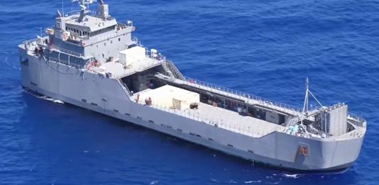
The prison ships: The identical 2,500-tonne logistics supply ships and landing craft Nahshon and Komemiyut were provided to and financed by the US for Israel in August 2023 and July 2024 respectively. Both were used in the hijacking of the Global Sumud flotilla after being converted into prison ships. On 29 April, one of the two ships was in action; on 18 May, both were.
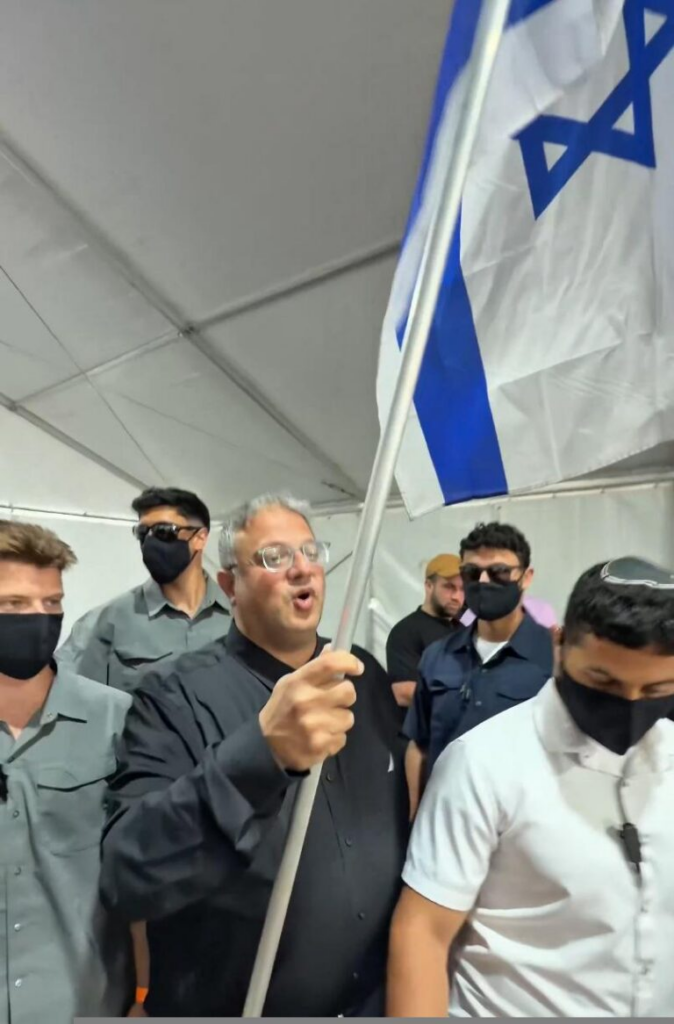
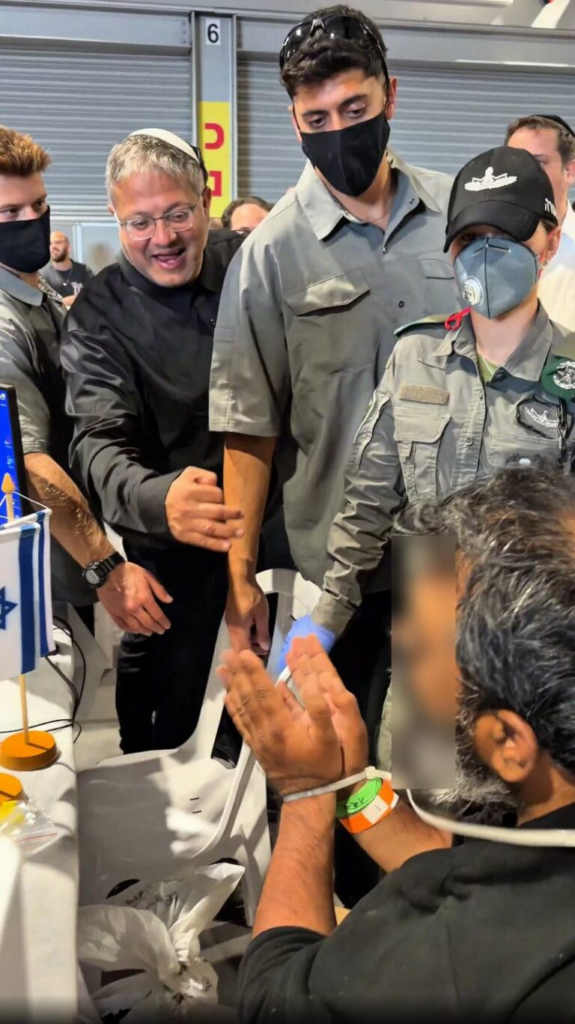
The extrem far-right, religious-fundamentalist Israeli Minister of Police, Ben-Gvir, at the port of Ashdod: he posted videos of the kidnapped victims on X
Trigger warning: description of physical and psychological violence
The prisoners’ worst fears on the torture ship came true on the second morning, 20 May. We docked at the Israeli port of Ashdod, south of Tel Aviv. Bound with cable ties, we knelt for over an hour on the ship’s steel deck, our heads on the ground, our backs sunburnt. Some people had their arms painfully bound behind their backs. For the first time, I was truly afraid. Would the violence continue to escalate? Would I suffer lasting damage? Would I have the steadfastness, perseverance and endurance known in Arabic as sumud?
A large crowd had gathered on the shore to await the arrival of the ‘torture ship’ – including the Minister of Public Security, Ben-Gvir, as we later learnt. On X, he posted a video of the inhumane treatment, which the German Ambassador to Israel described as “utterly unacceptable and incompatible with the fundamental values of Germany and Israel”. The UK condemned the violation of “the most basic standards of respect and human dignity”. The US Ambassador condemned Ben-Gvir’s behaviour as “despicable”. He had “betrayed the dignity of his nation”.
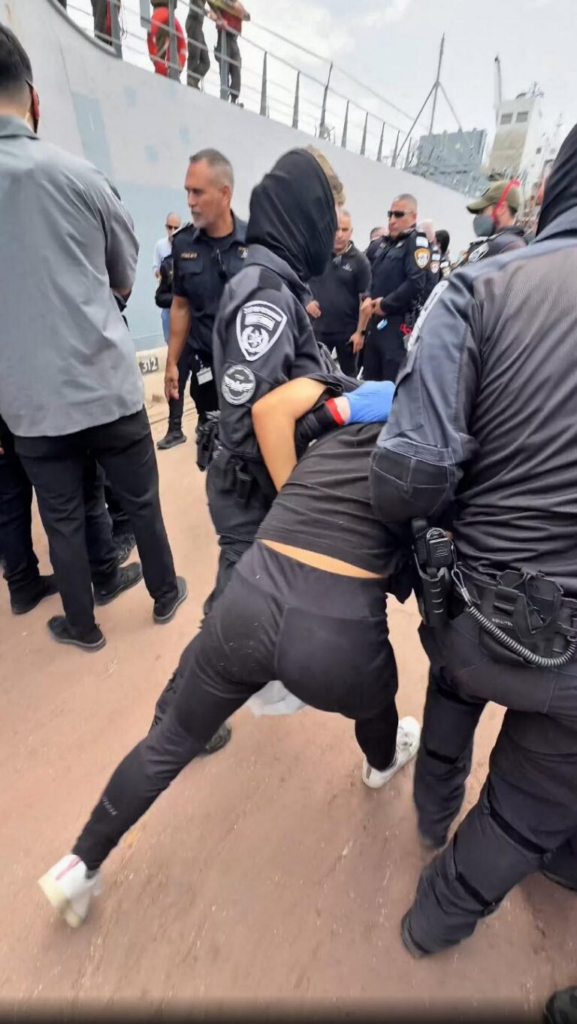
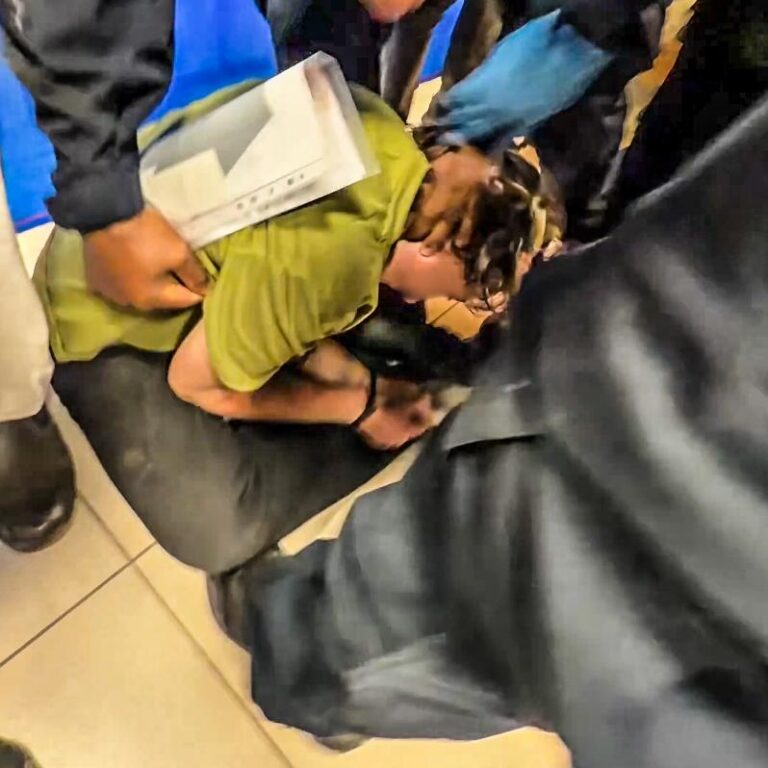
In Ashdod, two soldiers forcibly pressed my neck downwards and drove me towards a large white tent. I lost my footing; they lifted me up to shoulder height and hurled me onto the concrete floor of the tent. I managed to roll away, but the ribs beneath my left arm were in pain – a bruised rib, as an orthopaedic surgeon later diagnosed.
Arrival of the prison ship in Ashdod: Peaceful prisoners are dragged violently from the deck and pinned to the ground
“On your knees!” someone shouted at me. Was it two hours that we remained like that, constantly threatened, whilst Israel’s entry for the 2026 Eurovision Song Contest played on a loop? Many could no longer kneel. Later, I examined a man with severe grazes and bruises on his knee, which he could no longer bend after this ordeal. Anyone who asked for the tight cable ties on their forearms to be loosened because they were losing feeling in their fingers and their hands were swelling was mocked, insulted or threatened. Then a party atmosphere took hold. The soldiers and prison guards joked, partied and danced to disco music. I heard a drone and imagined it filming hundreds of people, bound, tortured and kneeling on the concrete floor, whilst the torturers celebrated their successful day in high spirits.
We were tortured, but we knew all along that we would not be killed and would be released after a few days. Governments from over fifty countries and an attentive media would protect us. Palestinians do not have this protection; they face the death penalty. I am shocked and saddened by how many of the Israeli soldiers I encountered have had respect for human beings systematically drilled out of them. They were clearly encouraged to torment people, to shoot at them, to humiliate them, to spit at them, to insult them, to beat them, to kick them – and to laugh and dance whilst doing so. It terrifies me that people in Palestine, in the territories occupied by Israel, have to deal with soldiers on a daily basis who do not recognise the dignity of other human beings. That is why the more than four hundred participants in the Global Sumud Flotilla set sail for Gaza despite the high risks – to protect these people.
Police Minister Ben-Gvir mocks prisoners from the Global Sumud Flotilla who were forcfully abducted to Ashdod
Reception for the 428 activists of the Global Sumud Flotilla at the passenger terminal: border police (Magav) in their olive-green combat uniforms, regular police officers in blue shirts and civilian employees of the immigration authorities and other agencies. Signposts, information boards and barriers. “Head down!” A policeman forced me, with one hand on the back of my neck, to the next station, to the next policeman. In his other hand he held the document folder containing my passport, documents from the prison ship, passport and ID photos, prints of both index fingers and forms regarding my alleged illegal entry and consent to deportation – unsigned.
The 428 people taken hostage on the two prison ships were mistreated in the passenger terminal at Ashdod
Sometimes my back was forcibly pressed down until it was parallel to the floor; sometimes a tilt of the head was enough. An immigration officer: “Do you know why you are here?” “I don’t wish to answer.” “No idea why you are here?” “I don’t wish to answer.” “You are a doctor. You are clever. Why do you not wish to answer?” “I don’t want to answer this question either.” “You Germans have already made one big mistake in your history…” He did not give a reason for the kidnapping.
“On your knees!” A waiting area for those bound with cable ties. Chairs stood in front of the officials’ desks; some were made to kneel there too. A brief conversation with the lawyer from the Legal Centre for Arab Minority Rights in Israel (Adalah). A policeman sat nearby. A judge asked me and others how we were. A civilian employee shouted at me angrily: “A Nazi from Germany!” “A Fascist!” He didn’t scare me. The potentially violent Magav border police, on the other hand, I took seriously. “You know Holocaust?” Eye contact. “Yes.” “You are a Nazi!?” “No.” One of them shouted at me furiously: “Did you touch me?!”
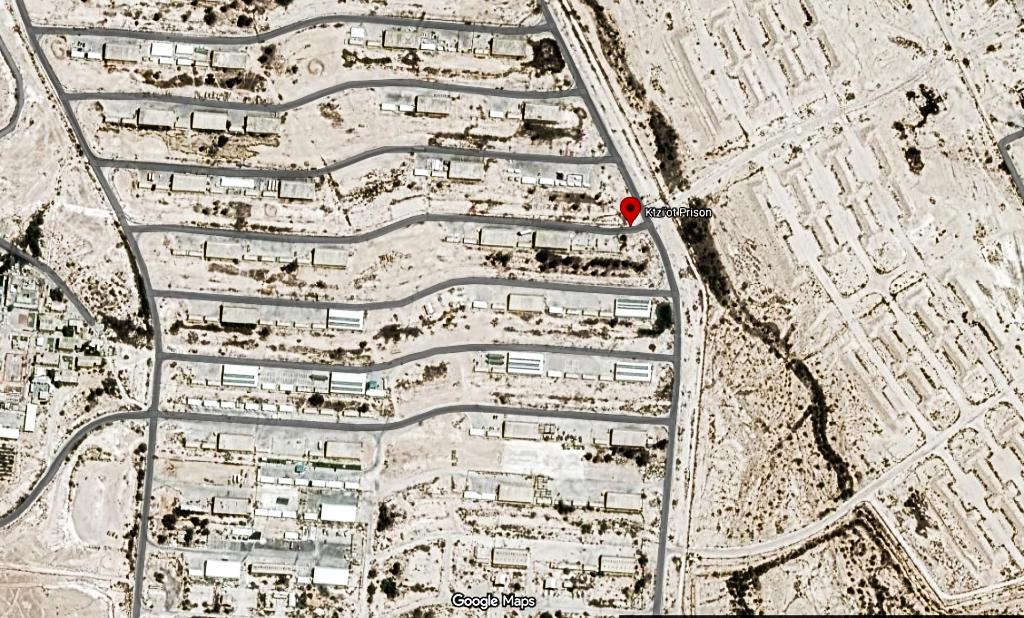
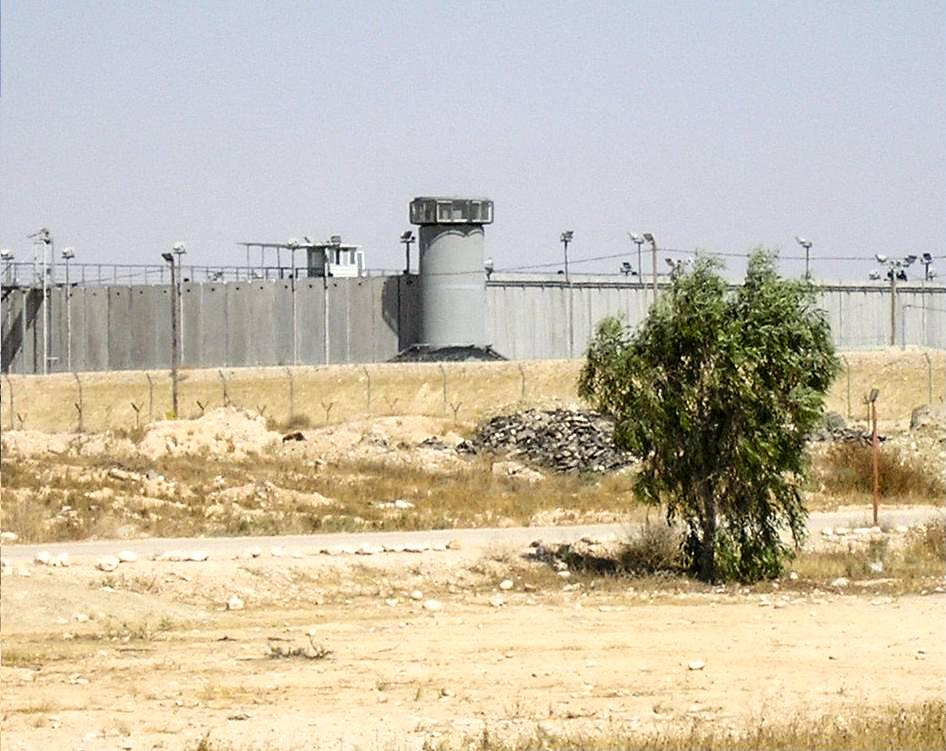
Ktziot Prison in the Negev Desert: the largest Israeli prison
20 May 2026, afternoon: handcuffs and leg irons instead of cable ties in the prison van, sixteen people in two rows, steel benches, lights and windows barred. A person with a face contorted with pain, hands tied behind his back, his right shoulder aching. Handcuffs digging deep into swollen wrists. “We need a doctor! Loosen the handcuffs!” we banged on the iron door. “Don’t do that again!” we were threatened. I pressed the swelling with my thumb and index finger; after a few minutes, we managed to move the handcuffs a few millimetres. The pain remained. We were freezing; the air conditioning was on. No doctor, no loosening of the handcuffs.
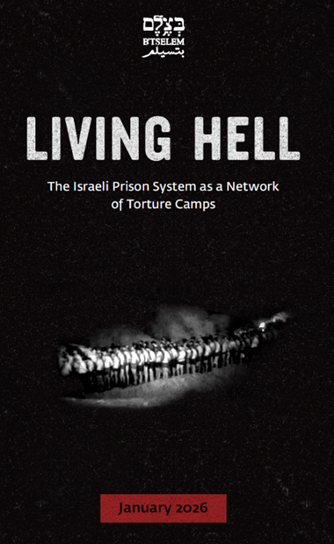
20 May 2026, evening: Ktziot Prison in the Negev Desert, high walls, covering 400,000 square metres, holding up to 6,000 prisoners, most of them in tents. “Welcome to hell: the Israeli prison system as a network of torture camps,” was the headline used by the Israeli human rights organisation B’Tselem. Fifty-five Palestinians who had been released from Israeli prisons and detention centres gave evidence in the report – almost all had been detained without charge or trial. One described Ktziot as follows: “A facility where you are sent and suffer severe, deliberate and unrelenting pain, no matter who you are or why you were arrested.” The British Guardian had already run a headline in August 2024 reading: “Torture, abuse and humiliation: Palestinians describe ‘hell’ in Israeli prisons”. Former prisoners reported sexual assaults and starvation in prisons described as “torture camps”, under the leadership of Police Minister Itamar Ben-Gvir. And the BBC ran the headline in April 2025: “Chemical burns, physical injuries, electric shocks”. One man recounted how he had been set alight with chemicals.
Strip naked, three squats, a photo, a grey tracksuit as prison garb, rubber slippers, a numbered wristband. “Faster! Faster!” Handcuffed, clutching the jumper of the person in front, eyes fixed on the floor, we ran in single file past barking dogs. “Look down!” Thirty people in a nine-square-metre cell with a bunk bed and a shower that doubles as a urinal. Short of breath. A trickle of air flowed down from the small barred window; the most sought-after spots were on the floor. My vision went black; I had to sit down quickly. Two people squeezed into the gap under the bed. We banged on the door, chanting: “We need air!” The door was flung open, threats. I was able to give a cursory examination to a few of the injured – suspected broken ribs and forearms constricted by handcuffs.
People were brought in or called out. The prison guards didn’t know which cells the prisoners were in. They couldn’t read or pronounce some of the names properly. One prisoner helped by reading them out. Then we walked in small groups across the prison yard to a covered hall. “Do you know what this is?” A video showed people who had been killed and abused. One replied: “October 7th.” “And who did that?” “Hamas.” “And you are helping them!?” “No.”
With a mattress and blanket tucked under my arms, I was greeted with open arms by my fellow prisoners in a barred tent. Relief. The prison guard hurled an empty water container at the backs of my knees. Fifteen bunk beds; the top one next to the entrance was mine. I stretched my arms outwards; the handcuffs were removed. Outside, the video continued to play. Then I attended to the injured. I could do very little, yet the injured were grateful. At the very least, I hoped I would be able to recognise any potentially life-threatening deterioration in their vital functions. Suspected broken ribs, bruises and abrasions on the face, grazed knees, forearms constricted by handcuffs, unclear abdominal pain following blunt force trauma. The water containers were filled by a prisoner. Should we drink the murky, brown water? Better not. A urinal and a small bucket for excrement within sight of the guards.
International reports and human rights organisations describe Ktziot as a notorious detention centre where systematic abuse and allegations of torture have been documented
21 May, morning: I was woken by a babble of voices. Lights on, a sandwich from a cardboard box, hands through the bars, handcuffs. The police were once again overwhelmed; two female staff members in plain clothes read out the lists of names. “Please”, “Thank you” – where shouting had previously been the norm. One prisoner remained as the last person in the cell, fearing reprisals. Fortunately, like all the other prisoners, he was leaving Ktziot that morning – presumably due to the critical media coverage.
Once again, my hands were tucked into the jumper of the man in front, as we passed the barking dogs. Where would the heavily armed prisoner transport vehicle take us? Jordan? The airport? We drove past deserts and mountains, oases and riverbeds, irrigated fields, and through villages.
21 May, midday: Hours of waiting at Eilat Airport, in southern Israel on the Jordanian border, 240 kilometres from Ktziot, until the terminal was cordoned off. Photographers were waiting for us; our handcuffs were removed. As I tried to walk towards the German consular staff, I was pushed away. I stumbled on, onto the tarmac, towards three Turkish Airlines planes waiting there.
The conditions of detention following the abduction of participants in the Global Sumud Flotilla violated international law
What we, as participants in the Global Sumud Flotilla, experienced in Ktziot Prison pales in comparison to what Palestinian prisoners have to endure every day within the Israeli prison system. Overcrowding and cramped conditions in the cells, coupled with a lack of fresh air, despite the fact that under international law, the International Covenant on Civil and Political Rights of 1966 (ICCPR) and the Mandela Rules, detention facilities must provide a minimum floor area and have sufficient volume and ventilation. Women prisoners from the flotilla reported that they had to endure hourly cell searches with dogs at night. Such searches have become an opportunity for prison staff to use violence and to humiliate and degrade prisoners.
The prohibition of torture is one of the cornerstones of international law. No state may deviate from it or suspend it in peacetime, in wartime or during a state of emergency. I knew that, as a privileged person with German citizenship, I had been abducted, and that the media would therefore be watching over my fate and that of the other Global Sumud Flotilla participants, and would protect us. Nevertheless, like most of the others, I was beaten and kicked whilst held as a prisoner on the prison ship, and during transport to Ktziot prison I was thrown to the ground from shoulder height and injured. Violence and the threat of it were my constant companions for three days. Other participants in the flotilla were tortured more frequently and more severely. What Palestinians endure was documented by the Israeli NGO B’Tselem in its August 2024 report “Welcome to Hell” and is unbearable.
“They stripped me by force, pulled down my trousers and underwear, and tied my shirt over my head like a mask.” “About 20 guards stormed into the cell I shared with five other prisoners, armed with batons, and beat us for about half an hour.” “One of the dogs bit a prisoner on the arm until he bled. Another dog bit me whilst I was being beaten.” “They also forced me to stand up, and through the blindfold I saw that they were wrapping an Israeli flag around me and filming me.” “One of the guards kicked my iron handcuffs hard with his shoes – I screamed in pain.” “Two of them stripped me, just like the other prisoners, and then threw me onto the other prisoners. One of them brought a carrot and tried to shove it into my anus.”
My thoughts and feelings are with the people who have had to endure such torture and still have to endure it.
Together against torture and cruelty in Israeli prisons!
“In September 2025, there were 10,863 Palestinians in Israeli prisons, including 350 minors. From the start of the Gaza war until December 2025, 84 Palestinian prisoners died there. The transformation of Israeli prisons into torture camps for Palestinian detainees is linked to Israel’s coordinated attack on Palestinians as a collective since October 2023 and the ongoing genocide in Gaza. The rampant violence and ethnic cleansing in the West Bank, as well as the persecution of Palestinian citizens of Israel, also have an impact on the treatment of prisoners. Foremost among these is the dehumanisation of Palestinians as a group and the use of extreme violence against them.” (B’Tselem, Living Hell, January 2026).
The author took part in the Global Sumud Flotilla. His name is known to the editors.
Responsible under press law:
Name: Chamberlain Address: Lahnstr. 1, 60326 Frankfurt am Main Email: sumud_flotilla@proton.me
Data protection
The data controller determines, either alone or jointly with others, the purposes and means of processing personal data (e.g. names, contact details, etc.).
Withdrawal of your consent to data processing
Certain data processing operations are only possible with your express consent. You may withdraw your consent at any time. To do so, simply send an informal email. The lawfulness of the data processing carried out prior to the withdrawal remains unaffected by the withdrawal.
Right to lodge a complaint with the relevant supervisory authority
As a data subject, you have the right to lodge a complaint with the relevant supervisory authority in the event of a breach of data protection law. The relevant supervisory authority for data protection matters is the State Data Protection Commissioner of the federal state in which our company is based. The following link provides a list of data protection officers and their contact details: https://www.bfdi.bund.de/DE/Infothek/Anschriften_Links/anschriften_links-node.html.
Right to data portability
You have the right to have data that we process automatically on the basis of your consent or in fulfilment of a contract transferred to you or to a third party. The data will be provided in a machine-readable format. If you request the direct transfer of the data to another controller, this will only take place to the extent that it is technically feasible.
Right of access, rectification, restriction and erasure
You have the right, at any time and in accordance with the applicable legal provisions, to obtain, free of charge, information about your stored personal data, the source of the data, its recipients and the purpose of the data processing, and, where applicable, the right to have this data rectified, restricted or erased. In this regard, and for any further questions regarding personal data, you may contact us at any time using the contact details provided in the legal notice.
SSL or TLS encryption
For security reasons and to protect the transmission of confidential content that you send to us as the website operator, our website uses SSL or TLS encryption. This ensures that data you transmit via this website cannot be read by third parties. You can recognise an encrypted connection by the “https://” in your browser’s address bar and the padlock symbol in the browser bar.
Contact form
Data submitted via the contact form, including your contact details, is stored so that we can process your enquiry or be available to answer any follow-up questions. This data will not be disclosed to third parties without your consent.
The processing of data entered into the contact form is carried out exclusively on the basis of your consent (Art. 6(1)(a) GDPR). You may withdraw your consent at any time. An informal email is sufficient to withdraw your consent. The lawfulness of data processing operations carried out prior to withdrawal remains unaffected by the withdrawal.
Data transmitted via the contact form will remain with us until you request its deletion, withdraw your consent to its storage, or there is no longer any need to store the data. Mandatory legal provisions – in particular retention periods – remain unaffected.
YouTube
Our website uses YouTube plugins to integrate and display video content. The video portal is provided by YouTube, LLC, 901 Cherry Ave., San Bruno, CA 94066, USA.
When you visit a page with an integrated YouTube plugin, a connection is established with YouTube’s servers. This allows YouTube to see which of our pages you have visited.
YouTube can link your browsing behaviour directly to your personal profile if you are logged into your YouTube account. You can prevent this by logging out beforehand.
The use of YouTube is in the interest of presenting our online services in an appealing manner. This constitutes a legitimate interest within the meaning of Article 6(1)(f) of the GDPR.
Details on the handling of user data can be found in YouTube’s privacy policy at: https://www.google.de/intl/de/policies/privacy.
Vimeo
Our website uses Vimeo plugins to embed and display video content. The video portal is provided by Vimeo Inc., 555 West 18th Street, New York, New York 10011, USA.
When you visit a page with an integrated Vimeo plugin, a connection is established with Vimeo’s servers. This allows Vimeo to determine which of our pages you have visited. Vimeo will receive your IP address, even if you are not logged in to the video portal or do not have an account there. The information collected by Vimeo is transmitted to the video portal’s servers in the USA.
Vimeo can link your browsing behaviour directly to your personal profile. You can prevent this by logging out beforehand.
Details on how user data is handled can be found in Vimeo’s privacy policy at: https://vimeo.com/privacy.